
Broken Garage Door Spring: 5 Signs and What to Do
A broken spring is the most common garage door failure, and the most misdiagnosed. People blame the opener, the remote, or the sensors when the real problem is a coil of steel above the door that finally gave out. Here's how to know that's what happened, and what to do (and not do) next.
The short version: if your door suddenly feels like it weighs a few hundred pounds and the opener strains but can't lift it, you almost certainly have a broken spring. Read on for the telltale signs, why this is the one repair we tell homeowners never to DIY, and what it costs to fix in the Norwalk area.
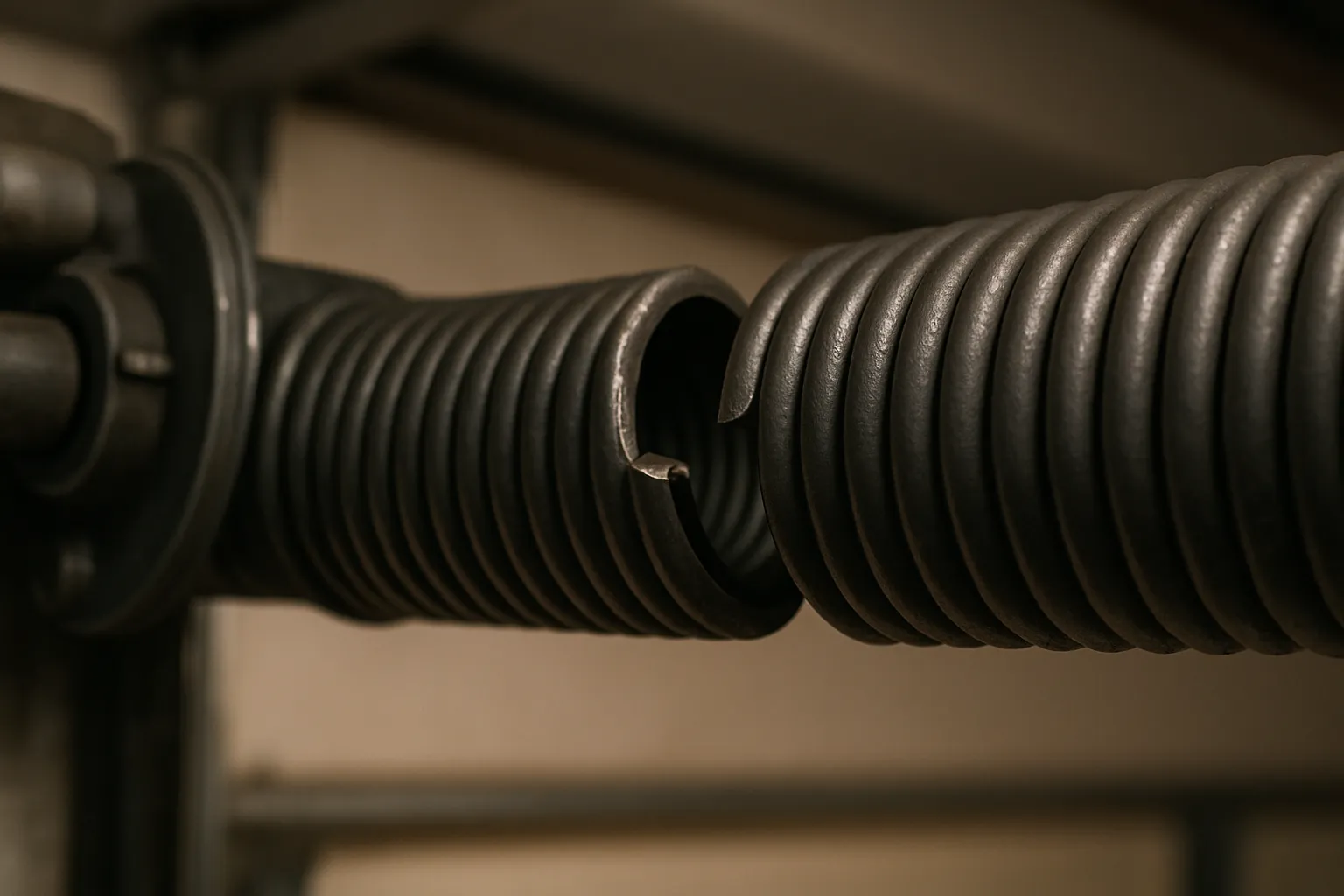
5 Signs Your Spring Broke
- You heard a loud bang like a firecracker from the garage
- The opener runs but the door barely lifts, then reverses
- There's a visible gap in the coiled spring above the door
- The door feels impossibly heavy if you try to lift it by hand
- The door opens a few inches and stops crooked
Any one of these on its own is a strong hint. Two or more together and it's almost certainly the spring. That loud bang, by the way, is the sound of the spring snapping under hundreds of pounds of tension. Plenty of Norwalk homeowners hear it in the middle of the night and think someone hit the house.
Torsion vs. Extension Springs
Knowing which type you have helps you understand the fix:
- Torsion springs mount on a metal bar directly above the door opening. They wind and unwind to lift the door and are the more common, longer-lasting design. When one breaks, you'll usually see a clear gap in the coil.
- Extension springs run along the horizontal tracks on either side of the door and stretch as the door closes. They're common on older single-car doors, including many of Norwalk's 1950s and 1960s tract homes. When one snaps, it often hangs loose or the door sits crooked.
Either way, the springs are what carry the door's weight. The opener just guides it. That's why a dead spring leaves even a strong motor useless. You can read more about the fix on our spring repair page.
Why DIY Is Genuinely Dangerous
This isn't the usual "call a pro" boilerplate. A torsion spring holds hundreds of pounds of stored tension. If it slips while you're winding it, the winding bar or the spring itself can break fingers, an arm, or worse. Emergency rooms see these injuries every year.
The specific hazards:
- The correct winding bars are required. Screwdrivers and rebar slip and turn into projectiles.
- Both springs and cables are under load at the same time, so a mistake on one can release the other.
- Getting the tension slightly wrong leaves the door dangerously unbalanced.
This is the one repair we tell homeowners never to DIY. The cost of a professional replacement is far less than an ER visit or a bent door.
What to Do Right Now
Stop using the opener. Forcing it against a dead spring burns out the motor and can bend the door. Then:
- Leave the door closed if it's already down. A door with a broken spring can slam shut without warning.
- Keep kids, pets, and cars clear of the doorway.
- Don't yank the red emergency release with the door open. It can crash down.
- Call a technician for a same-day fix.
If your car is trapped inside, wait for a pro rather than risking a manual lift. If the door does everything except the spring symptoms above, check our guide on a garage door that won't open to rule out other causes first.
How Long Springs Last (Cycle Life)
Springs are rated in cycles, where one cycle is opening plus closing once. Standard springs are rated for about 10,000 cycles, which works out to roughly 7 to 12 years for a typical household. Use the door more, like a busy family coming and going all day, and you'll hit that number sooner.
Norwalk's older doors are often well past their rated life. Original 1960s hardware on a home that's changed hands a few times may be running on decades-old springs. On top of age, our coastal marine-layer humidity in the mornings and hot inland afternoons rust springs and cables from the inside, weakening them faster than the cycle count alone would suggest. If your spring is old, budget for it before it strands you.
What It Costs to Fix in Norwalk
Here are honest 2026 ranges for the Norwalk area, part and labor included:
- Single torsion spring: $200-$320
- Two-spring torsion system: $300-$450
- Extension springs (single-car): $180-$280
If your door uses two springs and one broke, replacing both in the same visit is the smart move. They're the same age and have taken the same wear, so the second one usually isn't far behind, and you avoid paying a second service call. For the full picture on every repair, see our Norwalk repair cost guide.
Preventing the Next Break
You can't make a spring last forever, but a little upkeep stretches its life and warns you before it fails:
- Lubricate the springs, rollers, and hinges with a garage-door-specific lube twice a year to fight rust from the marine layer.
- Test the balance: pull the release and lift the door halfway by hand. If it won't hold position, the springs are wearing out.
- Listen and look for gaps in the coil, fraying cables, or a door that opens crooked.
- Replace in pairs so both springs age together.
Our SoCal maintenance guide walks through the full seasonal routine.
Get Garage Door Help in Norwalk
Think your spring is gone? Don't force the door. Call (562) 667-4784 for same-day spring repair in Norwalk, or request service online. We carry the common springs on the truck, so most jobs finish in one visit.
Questions, Answered
How long do garage door springs last?
Most are rated for about 10,000 cycles, roughly 7-12 years of normal use. Norwalk's older doors are often well past that.
Can I open my door manually with a broken spring?
Only with great care and usually two people. It's very heavy. It's safer to wait for a technician.
Is it safe to leave a broken spring for a few days?
Leave the door closed and don't run the opener. Forcing it against a dead spring can burn out the motor or bend a panel, turning a spring repair into a bigger bill. Same-day service is the safer route.
If one spring broke, should I replace both?
On a two-spring door, yes. Both springs are the same age and wear, so the second usually fails soon after. Replacing both in one visit saves a second service call.
How much does a broken spring cost to fix in Norwalk?
A single torsion spring runs $200-$320, a two-spring system $300-$450, and extension springs $180-$280, all in. Call (562) 667-4784 for an exact quote.
Need Help in Norwalk?
Garage Door Pro Norwalk provides fast, same-day garage door repair across Norwalk, CA and the surrounding area — flat-rate pricing, licensed and insured, with 24/7 emergency service. Landed on this article from a search? Head back to our homepage to see everything we do, or reach out now.